Caribbean Hurricane Network
- 2 0 2 6 Season -
| | home | tools | pleas for help | QHWRN | guide | climatology | archive | |
|
|
Caribbean Hurricane Network- 2 0 2 6 Season - |
|
| - - - 2026 Season - - - |
Weather discussions by Gert & Dave during the 2026 Atlantic Hurricane Season. The homepage with the links to local reports from the islands, latest satellite image, current weather outlook can be found here.
Wednesday, October 7, 2026 21:59PM EDT
- Isaias and the rest
Fay, located about 800 miles to the east-northeast of the islands, has been hanging around for a long time now (since Sep.20), but is on its last legs. The final advisories have just been issued. Short lived Gonzalo did form near the Cape Verde, but wasn't the typical Cape Verde storm we fear so much. It did cause some damage on the Cape Verde Islands though and actually ended up as a tropical wave in West Africa! Hanna form 2 days ago, ~1000 miles to the southeast of Bermuda. This is also expected to be a short lived storm. No worries here.
Hurricane season ends November 30, so still some time left for some late activity. Hopefully it won't come. Stay tuned! -Gert
Sunday, September 20, 2026 06:18AM EDT
- TS Fay
Tuesday, September 1, 2026 06:57AM EDT
- TS Edouard
Good morning,

While the Atlantic Basin remains on the quiet side, especially with
the demise of TS Dolly, which, in a normal season sans Super El Nino,
would have probably became a major hurricane that recurved before the
island chain, the Eastern Pacific is frenetic while the GOM/GOA is
dealing with a homegrown TS named Edouard.

The remnants of Dolly, whose fast forward speed contributed to her
lack of intensification along with the SAL and wind shear, did not
bring as much rain as was anticipated to the NE Caribbean, although
any rain was welcome in this drought-ridden region. As Gert shared
earlier, those remnants have a low chance of re intensifying while
bringing blustery weather to the Bahamas plus the Turks and Caicos.
Elsewhere in the Atlantic, a few low riders will continue their march
westward with little opportunity of development. However, there are
several potent waves on the African continent that could alter our
future scenario.

Small core TS Edouard, semi paralleling the Gulf Coast off Louisiana
will be investigated again today by the hurricane hunters. A small
core system is capable of rapid transformations in intensity, up or
down. In this case, it will be up. TS Edouard will be traveling over
extremely warm waters near the coast as he approaches landfall. Rapid
Intensification upon approach to the coast of the LA/TX border,
including Houston's infamous flood prone infrastructure, is a good
possibility with Cat 1 potential at landfall. Not cut in stone though.

Regardless of a strong TS or minimal Cat 1 landfall, the results will
be virtually the same. While much needed and blessed rains will occur,
they will occur over concrete and concrete like dry, drought ridden
land resulting in major runoff with accompanying flash flooding.
Strong, increasingly gusty winds will lash the coast with coastal
erosion/flooding, storm surge, power outages, the usual suspect list
of a landfalling tropical system of this magnitude. If he landfalls
closer to Houston, the oil industry located in the port will likely
sustain damage as well although they have gone through this rodeo
before. Smaller storms have caused immense amounts of damage, largely
due to the copious amounts of rain in a short period of time.

Stay safe, prepared and vigilant.

Dave
Meanwhile Tropical Depression Five formed from Invest 97L, off the coast of Louisiana. It is expected to make landfall near the Texas/Louisiana border in about 24 hours. The TD is not moving that fast at the moment so it might produce quite a lot of rainfall. Expect some flooding in the concrete prairie of Houston. Elsewhere it's quiet! -Gert
7:55PM update: Tropical Depression Five was upgraded to Tropical Storm Edouard. It should stay 'just' a tropical storm before it makes landfall, but with these warm waters you never know.
Thursday, August 27, 2026 21:49PM EDT
- TS Dolly
Good evening,

While the Eastern Pacific is rife with action and Hawaii taking the
brunt of most of that action, the Atlantic, GOM/GOA and Caribbean Sea
have been experiencing a welcome dormant scenario so far this 2026
Atlantic hurricane season which we all in this region appreciate. This
is due to the strengthening El Nino producing prolific wind shear,
cooler than average Atlantic SST's, and our favorite protector, the
good old reliable, and omnipresent Saharan Dust Layer.

The downside to all these factors is a persistent drought from the mid
Windwards up to the Greater Antilles. Puerto Rico is especially bereft
of Agua aka water with rationing in effect for almost 1/2 million
residents.The DR, US and British Virgins along with Antigua and the
rest of the Leewards are experiencing drought in various phases. The
lower Windwards have been the beneficiaries of low riding waves, just
below the Saharan Dust reach and out of the claws of the wind shear.
However, this is about to "possibly" change but not end the drought in
the northeastern sector completely.

TS Dolly, materializing right after Dolly Partons passing, which,
while a major coincidence, is not a planned name event as names for
storms are recycled every 6 years. The timing is impeccable I must
say. I also hope TS Dolly is as gentle and generous with rain only as
Dolly Parton was with her love of humanity and philanthropy.

Currently Dolly has a chance to slightly strengthen but that window is
closing rapidly as wind shear and dry air are conspiring to instigate
her demise before she reaches the Lesser Antilles. However, there will
be residual effects as in possible flash flooding due to the hard
packed, drought ridden grounds and steep terrain, coastal flooding,
rip currents, intermittent power outages which happen anyway, and high
offshore seas.

Models are in good agreement as to the track although a slight
deviation to the north will lessen all the above effects while a
deviation to the south will enhance said effects. A stronger system
will recurve before the islands due to the steering currents and the
strength of the system but Dolly is expected to weaken upon approach,
possibly back into a strong tropical wave. Thank you dust and wind
shear. Dolly could still exceed expectations so please, prepare
regardless. Weather is an inexact science and we have seen previous
systems overcome the obvious obstacles, over achieve, and surprise.
Err on the side of caution.

After passing the islands, regenesis is a small possibility due to
less wind shear and dust plus warmer SST's. Just something for the
Turks and Caicos, Bahamas and Florida to be aware of. Depends on her
strength upon exiting the NE islands.

Behind Dolly, there are waves lined up, per usual at this time of
year. There are a couple who bode a vigilant eye, with the next one on
the list. Dolly has paved the way, albeit slightly by moistening up
the environment so time will tell.

Stay safe, prepared and vigilant. There's a lot of season left and the
meat of the season is at hand.

Dave
Models don't really agree yet on what will happen (see multi-model grand ensemble below). Those that predict a stronger storm will have it veer more to the north, moving the system just north of the islands (but be on alert Bermuda). The ones that predict a weaker system have it track more to the south. Right now tracks are trending southwards, so I guess to less intense development.
Squinting my eyes at the intensity guidance plots tells me that most models keep the system at just a tropical depression, but some see a Category 1 hurricane form... One of the better performing models, Google's Deepmind AI model, sees it become something when it is getting close to the Turks&Caicos and Bahamas. It is all still a little early to tell, if we get rain, rain+wind, or none... Stay tuned! -Gert
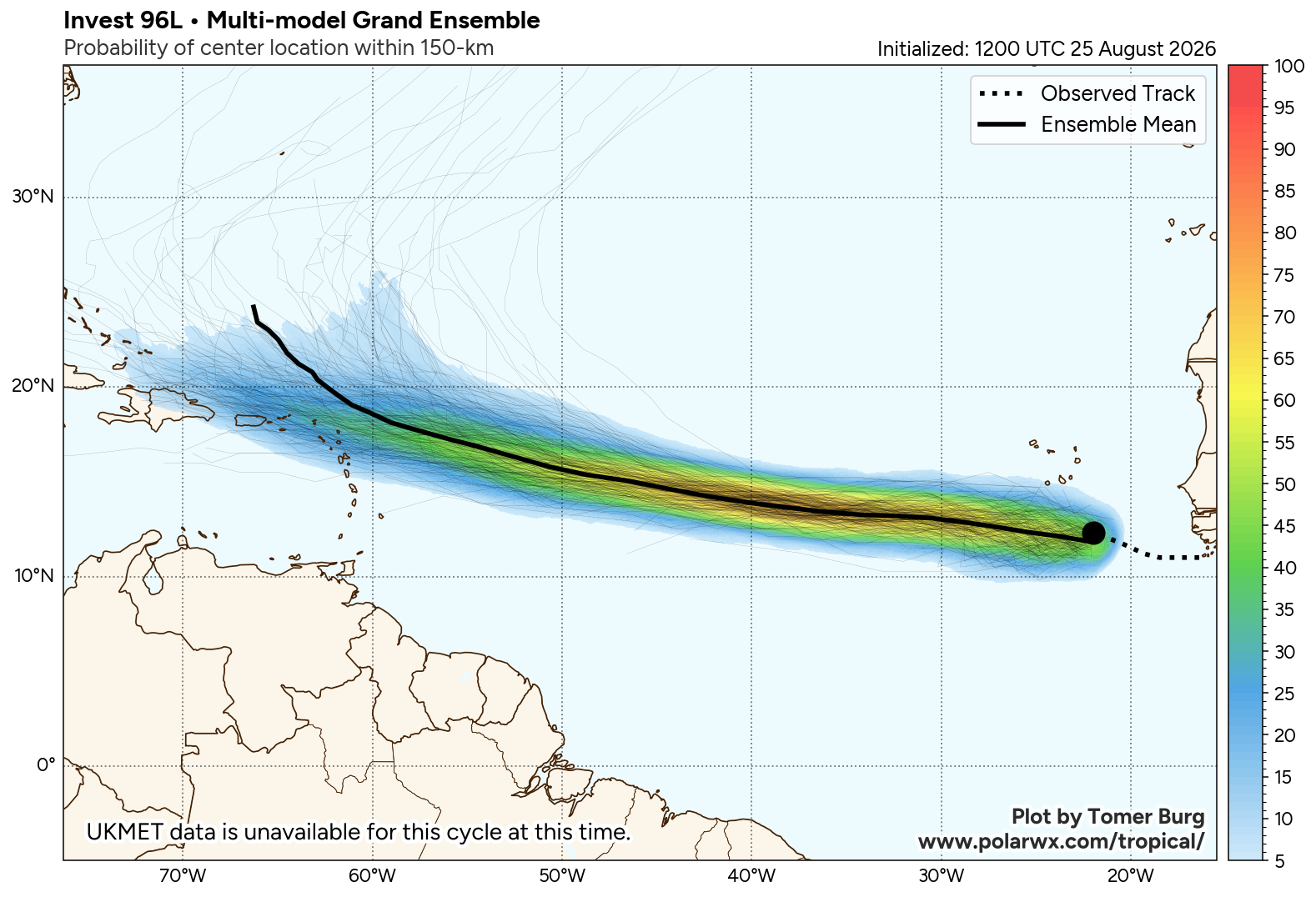 |
| Multi-model Grand Ensemble August 25 (source: PolarWx.com) |
The wave shows up very clearly on the EUMETSAT Convection and Air Mass images, that can be found on the satellite page. I was recently able to get those EUMETSAT images going again, since their website has stopped serving the static images that I was retrieving. With no storms on the horizon I had time to do some other fixes/upgrades as well. I got the My Satellite tool, an island-centered satellite loop, going again, with a new tool that you can easily check with your mouse cursor the distance of a specific feature to your island of interest. Check it out here.
I also changed the way how I track new and current invests (those that are listed in pink above). New invests should now show up faster, within 30 minutes after officially declared. And lastly, something I announce previously, the most popular tool on my website, the Closest Point of Approach tool, is now also available for the North Eastern and North Central Pacific. They currently have 3 active tropical storm, the flip-flop situation of the El Nino effect. Find the prefilled "How close can it get" forms here. Locations include many places on the Hawaiian Islands, Mexico and some in California.
If you want to support this no-ads website, please donate! As you would expect, with no storms, donations are way down, but my expenses stay about the same... Hope this helps all of you staying safe! -Gert
Saturday, August 15, 2026 17:08PM EDT
- Atlantic fizzle
There are however two Invests in the Atlantic that are approaching the Caribbean islands. Yesterday they were looking a lot more impressive, and seemed certain to become the next named storm(s). Today it is a bit different.
Invest 92L, about 400 miles east of the islands is getting battered now by upper-level wind shear and dry air, not conducive for strengthening. It sits quite low (south), and will move over the Barbados, St.Lucia, St.Vincent area tonight and tomorrow, bringing some heavy rains and gusty winds. I have just fixed the 'My Satellite" tool, it shows a satellite loop centered on your island of choice. There were some server problems with it that I was able to recently fix. Check it out here, if you are curious about the approaching storm.
The other invest, 94L, is about 1000 miles east of the islands. That one still has a 50% chance to develop into something over the next 7 days. It also sits pretty low, but is expected to veer more to the north. Right now (still early to tell though) it looks like it might be located just north of the northeastern islands Wednesday/Thursday. Half of the models make it a tropical storm, just 1 a hurricane (see model spaghetti plots link above). Let's see how that one develops.
Meanwhile in the Pacific, Tropical Storm Lala is heading towards Hawai'i. As it looks right now, the center of the storm will actually go just over the southern tip of the Big Island as a Category 1 hurricane on Saturday (see the Closest Point of Approach calculator this Pacific storm. The biggest worry will probably the torrential rain associated with this system (up to 24 inches on the east side of the island!). Stay safe everybody! -Gert
Saturday, August 8, 2026 20:00PM EDT
- Inevitable
They conclude with these wise words: "As with all hurricane seasons, coastal residents are reminded that it only takes one hurricane making landfall to make it an active season. Thorough preparations should be made every season, regardless of predicted activity.. Indeed, a well below average season doesn't mean that no hurricanes will form. They still predict 9 tropical storms (we had 2, so 7 more, 14.4 is normal), 4 hurricanes (we had 0 so far, 7.2 is normal) and 1 major hurricane (3.2 is normal). The probability for at least one major hurricane tracking through the Caribbean (a large area) is 17% (47% is normal). A relative small chance, but there's a chance... Stay safe and enjoy the quiet conditions for the time being, although I guess we could use some rain! -Gert
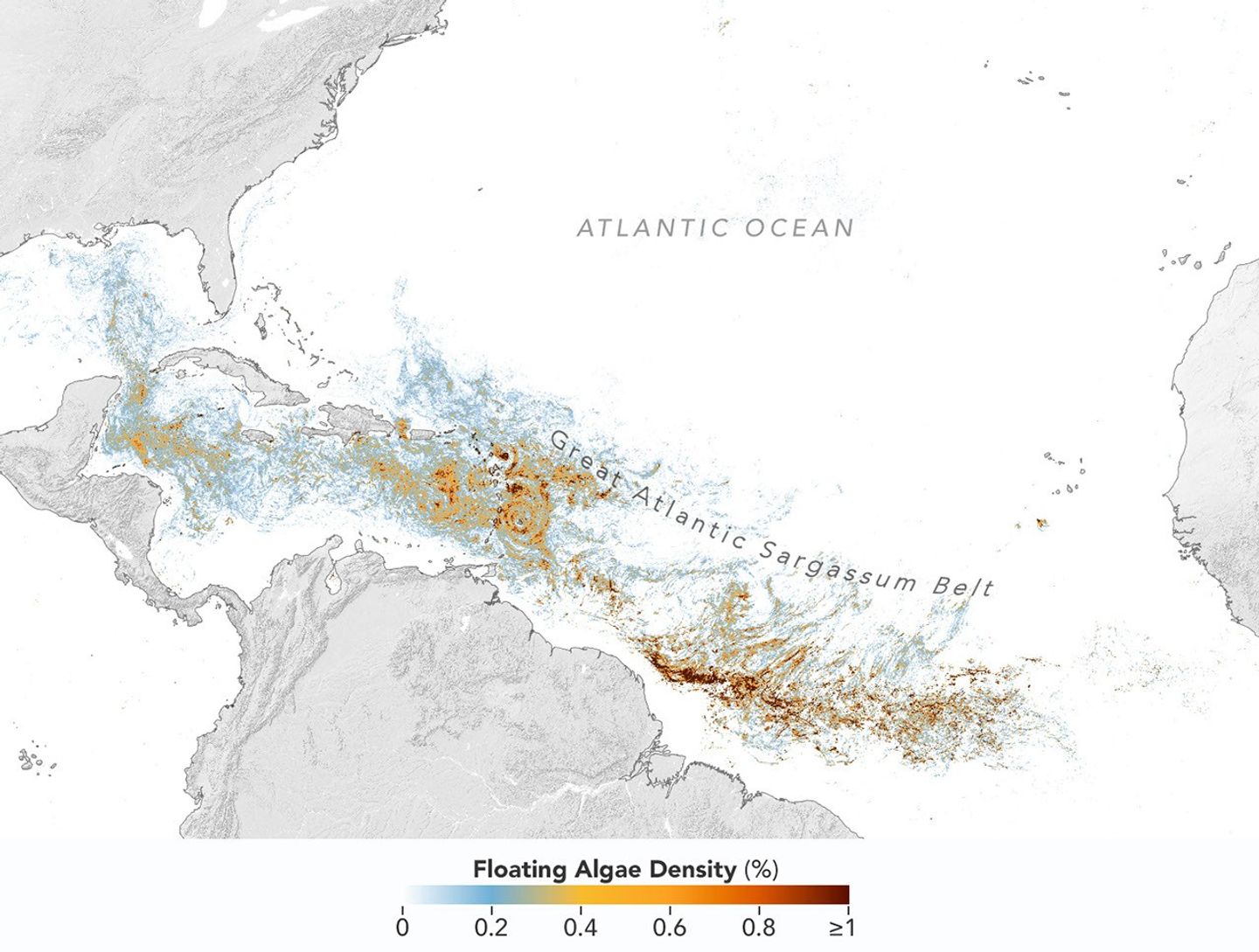 |
| Great Sargassum Belt June 2026 [source: NASA Earth Observatory) |
Although sea surface temperatures are plenty warm, this storm is not expected to become a hurricane due to some wind shear and the relative close proximity to land. Although the advisories seem to be most worried about the storm surge, which is understandable since it is moving west towards Louisiana, I think that the main problem will be the rainfall. Bertha is moving at just 3 mph, and we all know how much rain that locally can bring... You can use the tools above to check how close the storm will get to you and at what time. I have listed coordinates of Gulf cities to make it easier for you. Stay safe everybody! -Gert
Sunday, July 19, 2026 07:17AM EDT
- Dust and 91L
The main reason for the well below-average numbers is the developing El Nino, which should be a very strong one at the peak of the season. In the Atlantic El Nino's increase vertical wind shear, which will suppress development of tropical storms. The opposite is actually happening in the Pacific, where the warmer sea surface temperatures and weakened trade winds increase activity. Indeed, the Pacific saw two super typhoons already... Even though the Atlantic season might be well below average, we still have to stay alert. Just one big storm hitting your island, or just a wet tropical storm stalling where you live, will spoil your whole season. So we still need to be prepared! Stay safe everybody! -Gert
Tuesday, June 16, 2026 14:36PM EDT
- PTC 1 (Arthur?)
Main reasons for the lower forecast is the 'official' arrival of El Nino as NOAA announced today (see news release). They see a 63% chance of above normal sea surface temperatures in the Pacific 'El Nino' region of 2.0°C (3.6F). This would meet the criteria of a very strong El Nino. Another factor for the lower forecast is that sea surface temperatures in the Atlantic are for a change near or below average, instead of above average.
Below I summarized the probability of at least one major hurricane moving within 50 miles for the Caribbean islands, compared to the long term average (1880-2020). The probabilities are basically half of normal! Full list, incl. US States can be found here. Note that these probabilities are heavily biased by island/region area, for example the Bahamas, being a large region, will have a higher chance of a direct hit.
In spite of the expected slow season and low probabilities we should not take our guard down. Just one storm in your backyard will spoil your whole season. In 2024 Grenada had only a 1% probability of seeing a major hurricane, and then came Beryl... So you still need to prepare, regardless of the forecast. But it is a good feeling that it might be a nice and boring season. -Gert
 |
| Probability of a major hurricane traveling within 50 miles |
Below the names and pronunciations of this year's players. The list is repeated every 6 years, but new names are introduced if the storm was very deadly or costly. There were 3 names from the record breaking 2020 season with 30 storms (!) retired, Laura, and the Greek letter-storms Eta and Iota. During this covid year, Laura went over the northern islands as a tropical storm and finally made landfall as a Category 4 storm in Lousiana. Back to back storms Eta and Iota both made landfall as a Category 4 along the Miskito Coast in Nicaragua. Covid for sure did not help with the recovery effort in Central America. Eta and Iota are not replaced, since the WMO are not using Greek letters anymore when we run out of names, but a separate list.
Name         Pronunciation       Name         Pronunciation
--------------------------------------------------------------------
Arthur       AR-thur             Leah         LEE-ah
Bertha       BUR-thuh            Marco        MAR-koe
Cristobal    krees-TOH-bahl      Nana         NA-na
Dolly        DAH-lee             Omar         OH-mar
Edouard      eh-DWARD            Paulette     pawl-LET
Fay          fay                 Rene         re-NAY
Gonzalo      gohn-SAH-loh        Sally        SAL-ee
Hanna        HAN-uh              Teddy        TEHD-ee
Isaias       ees-ah-EE-ahs       Vicky        VIH-kee
Josephine    JOH-seh-feen        Wilfred      WILL-fred
Kyle         KY-ull
Let's hope that it will be indeed a below normal season, but we all know, one big one hitting your island will spoil the whole season for you. Best to start preparations now, check your hurricane shutters if you have, emergency food/battery supplies, etc. You know the drill.
This is year 31 that we are covering the storms for you on the islands! I made the website all ready for the next season, which involves quite a lot of file moves, etc. The big change this year is that thanks to a generous donor from St.John, I decided to get rid of the Google Ads. They were ugly and didn't bring up that much money anyway. The only ad is for Gobeach Vacations, without them this website would never have existed. Donations are still needed of course, you can donate with credit card, PayPal, Venmo and Stripe. Stay safe everybody this season. Don't do stupid things! -Gert
Tuesday, May 26, 2026 09:48AM EDT
- Upcoming 2026 Atlantic season
 |
| Saipan and Tinian caught in the eye [source: Eye on the Storm] |
The main suppressing factor playing this season is the development of a possibly super El Nino later this season (see for example this Eye on the Storm blog post by Henson and Masters, Yale Climate Connections). An El Nino usually suppresses hurricane formation due to stronger vertical wind shear and lower humidity in the atmosphere. The forecast could have been even lower if it wasn't for the above average sea surface temperatures in the tropical Atlantic (although temperatures are a bit cooler in the eastern tropical Atlantic (closer to Africa) due to stronger than normal trade winds). In 2023 we had a similar battle between El Nino and high sea surface temperatures. Unfortunately climate change won that year. Hopefully this year El Nino will win out.
Below I summarized the probability of at least one major hurricane moving within 50 miles for the Caribbean islands, compared to the long term average (1880-2020). Full list, incl. US States can be found here. Note that these probabilities are heavily biased by island/region area, for example the Bahamas, being a large region, will have a higher chance of a direct hit. Even though your probability is low, it doesn't mean you are out of the woods. Remember in 2024, Grenada had only 1% probability, but it did get hit that year with monster storm Beryl. So even if your chances are low, there is still a chance!
Tropical Storm Risk (EuroTempest) just came out with their forecast as well. That one looks even better. They expect a well below (40%) average season with 12 named storms, 5 hurricanes and just one major hurricane. They base it on the same factors, strong El Nino and near average sea surface temperatures. NOAA's forecast is expected late May. Also, please note that these early forecasts are not very reliable, so don't place too much trust in them.
Right now not much is going on. But we know storms will come each year. Now is a good time to get ready! Check your hurricane shutters, buy some extra canned food and water, etc. You know what to do, it is not your first time! Stay safe! -Gert
 |
| Probability of a major hurricane traveling within 50 miles |
Maintained & moderated by: Gert van Dijken (gert@gobeach.com).
Weather discussions also by Dave McDermott, St.Thomas, USVI.
|
GoBeach Vacations |
| Back to top | | home | tools | pleas for help | QHWRN | guide | climatology | archive | |